
California’s AB 732 and the New Policing of Farm Failure
Yanasa TV News
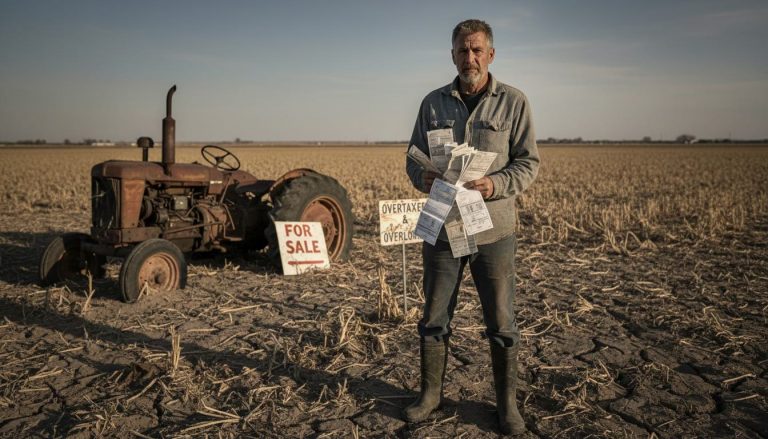
California agriculture is entering a new phase — not of innovation, not of sustainability, but of enforcement against economic collapse.
On January 1, 2026, Assembly Bill 732 quietly takes effect. There were no dramatic floor speeches. No prime-time news segments. No headlines announcing a fundamental change in how agricultural failure itself is treated under the law.

But for thousands of growers — especially in the San Joaquin Valley — AB 732 represents something new and dangerous:
The redefinition of farm abandonment as a punishable nuisance.

The Law, Plainly Stated
AB 732 expands the authority of County Agricultural Commissioners to address what the law calls “pest-related public nuisances.”
Historically, this authority existed — but enforcement relied on slow, procedural tools:
- Notices
- Orders
- Liens
- Cleanup conducted by the county and later recovered through property taxes
AB 732 introduces a faster mechanism: direct civil penalties.
Under the new law, if a crop — orchard, vineyard, or field — is deemed “neglected or abandoned” and capable of harboring pests that could spread to neighboring farms, a County Agricultural Commissioner may assess:
- Up to $500 per acre,
- Rising to $1,000 per acre if the landowner does not take “good faith action” after notice.
This is not theoretical. This is written authority.
The Context the Law Does Not Live In — But Farmers Do
On paper, AB 732 is framed as a pest-control and neighbor-protection measure.
In reality, it lands in the middle of a historic agricultural contraction driven by:
- Sustained low commodity prices
- Rising labor and input costs
- Escalating regulatory compliance
- And most critically, water loss under California’s groundwater regime
The Sustainable Groundwater Management Act (SGMA) has already forced thousands of acres out of production. Entire orchards have been mothballed — not because farmers are negligent, but because they no longer have water to keep trees alive.
Under AB 732, that distinction becomes legally irrelevant.
A farmer who cannot afford to irrigate may now be judged not as a victim of policy, but as the source of a nuisance.
The “Good Faith” Clause — Shield or Illusion?
Supporters of AB 732 point to the bill’s “good faith action” language as a safeguard.
The law does require:
- Notice
- An opportunity to be heard
- And a 30-day window for the landowner to take corrective action
But this raises an uncomfortable question:
What does “good faith” look like when the problem is structural, not behavioral?
Removing an orchard costs money. Grinding trees costs money. Replanting costs money. Maintaining pest control on land with no water costs money.
For many growers already operating at a loss, the “choice” becomes:
- Spend money they don’t have to comply, or
- Face escalating penalties for failing to do the impossible
This is not remediation.
It is coercion through insolvency.
A New Role for the County Agricultural Commissioner
AB 732 also shifts power — subtly, but decisively.
County Agricultural Commissioners are no longer simply technical advisors or enforcement agents. Under this framework, they function as:
- Risk assessors of neighboring harm
- Economic arbiters of what counts as viable stewardship
- And effectively, judge and jury over whether a farm’s decline has crossed into punishable territory
That is a profound change in the relationship between farmers and the state.
Failure is no longer just failure.
It is now actionable.
Why This Matters Beyond One Bill
AB 732 does not exist in isolation.
It fits a broader California pattern:
- Water restrictions without economic off-ramps
- Conservation mandates without compensation
- Climate goals enforced at the parcel level
- And increasing use of administrative penalties instead of negotiated solutions
The message is consistent:
If land no longer produces, it must still perform.
If it doesn’t, it becomes a liability.
What Farmers Are Quietly Asking
The quiet conversations happening across California ag communities aren’t about pests.
They’re about precedent.
If abandonment can be fined, what comes next?
- Mandatory rewilding orders?
- Forced remediation plans?
- Accelerated land turnover?
At some point, the line between stewardship and control disappears.
The Unspoken Question
AB 732 asks farmers to manage consequences they did not create — water scarcity engineered by policy, markets distorted by global forces, and compliance burdens that only scale operations can absorb.
And it does so with penalties, not solutions.
The unspoken question facing California agriculture is not whether pests should be controlled.
It’s this:
When farming becomes impossible, who is allowed to fail — and who gets punished for it?