
How Britain’s inheritance tax fight and environmental permitting are converging on family farms
Yanasa TV News
A rare court move signals deeper trouble
In early 2026, the UK High Court quietly did something it almost never does in tax cases: it ordered an urgent, two-day rolled-up judicial review of changes to inheritance tax reliefs affecting farms and family businesses.

A rolled-up hearing — where the court hears both permission to proceed and the full merits at the same time — is typically reserved for cases the judiciary believes are procedurally serious, time-sensitive, and potentially harmful if delayed. It is unusual in the tax context, where courts normally defer to Parliament and the Treasury.
The challenge targets reforms announced in the 2024 Budget by Rachel Reeves, which capped long-standing inheritance tax reliefs for agricultural and business property. The claimants argue the government broke its own tax-policy standards by pushing through a major structural change without proper consultation or impact assessment.
The court has not ruled on the substance yet. But the decision to fast-track the case is itself a signal: this is not being treated as routine fiscal housekeeping.
What changed — and why farmers say it’s existential
For decades, Agricultural Property Relief (APR) and Business Property Relief (BPR)allowed most working farms to pass land, buildings, and business assets between generations with little or no inheritance tax. The policy dates back to the 1980s and was designed to prevent farms from being broken up on death.
Under the reforms announced in 2024:
- Relief is no longer unlimited
- Qualifying agricultural and business assets are sheltered only up to a capped threshold
- Assets above that level face a 20% inheritance tax charge
After backlash from farming groups, rural MPs, and large-scale tractor protests, the Treasury raised the cap — but did not remove it. For married couples, combined allowances can shelter several million pounds in assets. For land-rich, cash-poor farms, that has not solved the core problem.
The issue is liquidity.
Farms often hold their value in land and stock, not cash. Inheritance tax bills must typically be settled within months. That leaves families with three options:
- Sell land
- Sell the operating business
- Borrow — if credit is available
Rural accountants and solicitors warned parliamentary committees that, under the new structure, perfectly viable farms can face six-figure tax bills without the cash flow to pay them, especially when probate delays and valuation disputes slow access to capital.
The House of Lords Economic Affairs Committee has already criticised the government for weak consultation and flagged the risk of forced sales, consolidation, and long-term damage to family-owned agriculture.
The judicial review: not about farming, but about process
Importantly, the High Court case is not a challenge to farming itself. It focuses on process.
The claimants — individual farmers and the campaign group Farmers and Businesses for Fair Tax Relief — argue that:
- The Treasury failed to conduct proper consultation
- Impact on farm viability and succession was inadequately assessed
- A long-standing settlement was altered without transitional protections
Even if the claimants succeed, the court is unlikely to strike down the tax outright. More probable outcomes include a declaration that the process was unlawful, forcing fresh consultation or revised legislation.
But that still matters.
A procedural ruling would slow implementation, expose internal government modelling, and set a precedent that structural changes to agricultural taxation require more than a line in a Budget speech.
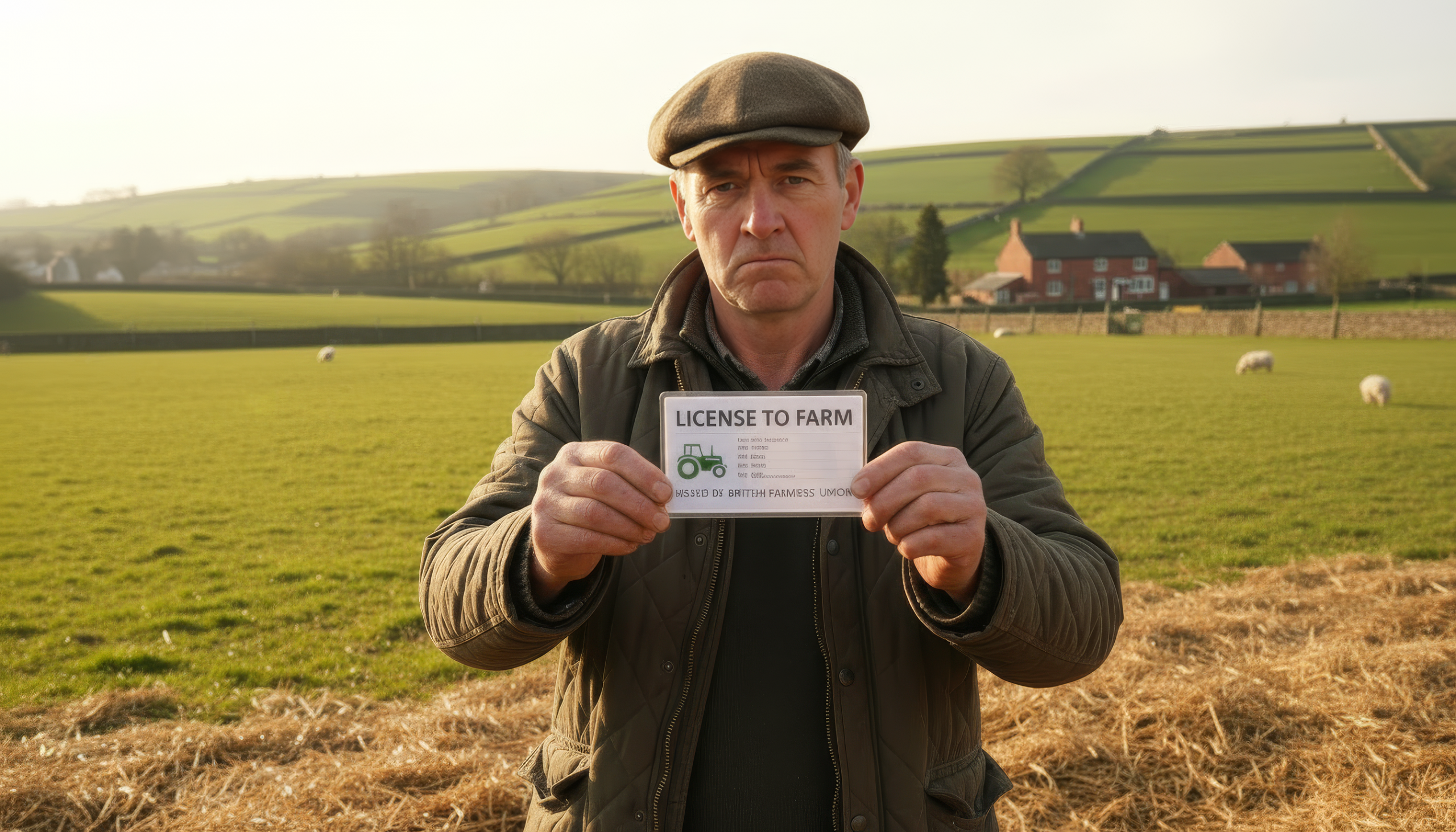
Where the “licence to farm” warning enters the picture
The inheritance tax fight is only one half of the story.
Running in parallel — and largely outside the courtroom — is an expanding framework of environmental permitting for livestock operations, overseen by DEFRA and enforced by the Environment Agency, with devolved equivalents elsewhere in the UK.
At present:
- Large dairy and beef units already require environmental permits
- Permits regulate slurry storage, nutrient runoff, ammonia emissions, and water pollution
- Non-compliance can lead to fines, suspension, or shutdown
What is changing is scope and ambition.
Policy discussions, consultations, and NGO modelling increasingly frame cattle farming through the lens of industrial emissions control — methane, ammonia, nitrates — rather than traditional land stewardship. Proposed tightening of standards would extend permitting requirements to a wider range of livestock operations and impose higher compliance costs.
There is no single law called “Licence to Farm.”
But permits determine who may operate, under what conditions, and at what cost.
For farmers, the concern is not semantic. It is structural.
Two choke points, one outcome
Taken separately, each policy might be survivable.
Together, they hit farms at their most vulnerable moments:
- Succession: Higher inheritance tax exposure forces asset sales at death
- Operation: Environmental permits require capital investment and ongoing compliance
This stacking effect creates a new risk profile:
- Families facing inheritance tax bills may lack capital to fund environmental upgrades
- Banks may price permit risk into lending decisions or refuse credit
- Failure to meet permit conditions can halt operations entirely
None of these policies explicitly say “stop farming.”
But together, they decide who can continue.
Critically, this structure favours:
- Cash-rich buyers over family successors
- Large operators with compliance departments over small holdings
- Consolidation over continuity
Ownership alone no longer guarantees the ability to farm.
From right to permission
This is why the phrase “licence to farm” has gained traction — even without a statute using those words.
When:
- A farm cannot be passed on without triggering major tax liabilities
- A farm cannot operate without permits subject to renewal, revision, or revocation
Farming shifts from a right attached to land to a conditional activity governed by administrative approval.
That transformation has occurred quietly, through layered policy rather than open debate.
Why this matters beyond Britain
The UK is often a policy laboratory.
Tax structures, environmental standards, and regulatory frameworks trialed there frequently reappear elsewhere — in the EU, in Commonwealth countries, and increasingly in the United States under different agency names.
The High Court’s intervention is not just about inheritance tax. It is about whether governments can fundamentally reshape agriculture through procedural shortcuts, while leaving the cumulative effects to work themselves out in rural communities.
The court has not yet ruled. But its willingness to hear the case urgently suggests something larger is at stake than revenue collection.
The question the court can’t answer
Even a successful judicial review will not resolve the deeper issue.
That question belongs to policymakers — and the public:
If a farm can be inherited only with significant tax exposure,
and operated only with permits that can be denied or withdrawn,
what does ownership mean anymore?
For Britain’s family farms, the answer may determine who is still farming a decade from now — and who is not.