Editor’s note — September 14, 2026: This article substantially replaces our earlier response to KGW. After reviewing the complete public record, Yanasa TV identified wording that required correction and material evidence that KGW’s report omitted. The original URL has been preserved so readers and search engines reach the most accurate version.
Originally published June 28, 2024. Last substantially updated September 14, 2026.
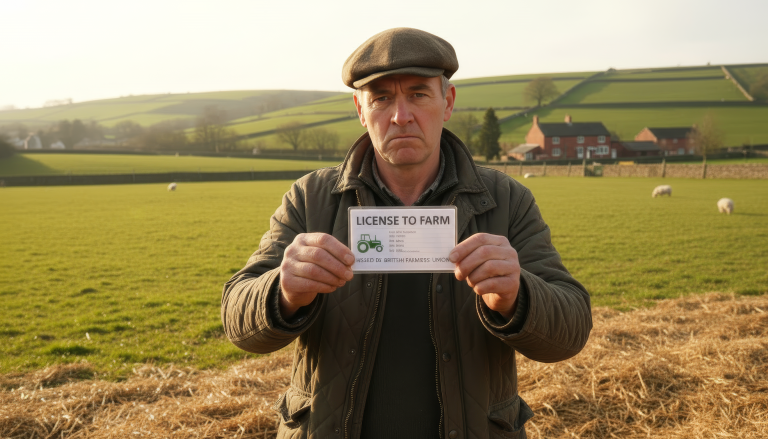
In March 2024, Yanasa TV published a video titled “Oregon Urgently Shuts Down Small Farms En Masse.” KGW later used that video as the centerpiece of a report about misinformation.
The original title was too broad, and some of our wording was imprecise. We should have distinguished between farms already prevented from irrigating commercial crops, small dairies facing an approaching compliance deadline, and farms that might be affected later. We also should have separated two different state actions involving two different agencies.
But KGW’s characterization left out evidence that was central to the story: a market garden whose owner said the enforcement action had essentially destroyed her business; 24 water-use notices issued in one district; a federal complaint in which four small dairies alleged substantial financial harm or possible closure; the state’s own acknowledgment that its dairy policy could have required permits from many small livestock operators; and Yanasa TV’s written and public responses before KGW aired its report.
This article puts those facts in one place.
KGW was correct about several narrow points: Sarah King had not already been closed, the Water District 2 letters were not formally cease-and-desist orders, aerial photography did not necessarily mean satellite imagery, and the original video combined two legally distinct disputes. But correcting those points does not resolve the larger question: whether Yanasa TV invented the threat to small farms. The subsequent record shows that it did not. The headline overstated what Yanasa TV could then quantify; it did not invent a nonexistent controversy.
Our corrections
We are correcting four points.
- Sarah King and Godspeed Hollow Farm had not already been formally shut down. King was still operating when Yanasa TV reported on her case. However, the regulatory threat was neither hypothetical nor remote. ODA had adopted its expanded CAFO interpretation, informed small dairies that the requirements applied to them and was preparing to begin enforcement on April 1, 2024. King and three other farmers filed their federal lawsuit in January.
Before the enforcement date arrived, ODA withdrew the policy and announced that it would not enforce it while the agency developed new rules. The department subsequently adopted narrower rules under which the four plaintiffs would not be subjected to the challenged requirements. Therefore, the precise correction is that King had not already been closed—not that the documented compliance threat prompting the lawsuit was imaginary or remote.
The plaintiffs’ complaint alleged substantial financial harm or complete shutdown, while individual farmers estimated compliance costs reaching tens or hundreds of thousands of dollars. See the federal complaint.
- The 24 Water District 2 notices were not formal cease-and-desist orders. OWRD described the 24 communications as informational letters notifying property owners of possible unlawful water use, warning that violations could result in penalties and directing recipients to contact the watermaster.
Nevertheless, OPB/KLCC reported that Oak Song Farm’s letter notified the farm that it could not irrigate commercial crops without a water right. For a grower without an affordable alternative water source, complying with that instruction meant stopping the disputed irrigation and, in some cases, stopping commercial production.
Yanasa TV should have used the agency’s correct document label. But describing the letters’ practical effect as requiring affected growers to stop operating was not invented; it reflected what recipients understood they had to do to avoid continuing an unlawful use. Without copies of all 24 letters, we cannot claim that every letter contained an express immediate command to cease operations.
- The confirmed detection method was aerial photography, not necessarily satellite imagery. OWRD’s regional manager told public media that officials used aerial photography, neighbor complaints and field observations to identify possible violations.
Friends of Family Farmers separately reported that enforcement could also draw on drive-by checks and farm advertising. We should not have converted “aerial photography” into the more specific claim “satellite technology” without proof of the image source.
- “En masse” exceeded what the published evidence established. The phrase was not supported by a verified statewide count. It conveyed a scale of completed closures that Yanasa TV had not established in its original report. The fuller record nevertheless documents a 24-notice enforcement initiative in Water District 2, lost commercial production at named farms in separate regions, statewide testimony concerning the same legal barrier and a separate dairy policy that ODA acknowledged could have required permits from many small livestock operators. The headline overstated what could be quantified; it did not invent the existence or cross-regional reach of the underlying problem. The evidence demonstrates consequences affecting multiple farms and regions—not an isolated misunderstanding.
Those corrections matter. So does the rest of the record.
Two separate events were being discussed
The original video combined two disputes that shared a theme—small farms facing potentially unaffordable regulatory consequences—but were legally distinct.
1. Market-garden water enforcement
Oregon law long required a water right to irrigate crops grown for sale, unless a specific exemption applied. At the time, a domestic-well exemption allowed irrigation of up to one-half acre for a noncommercial garden, but not the same garden when its crops were sold.
The best-documented early enforcement action occurred in fall 2023, when OWRD sent 24 informational compliance letters to property owners in Water District 2, which covers the southern Willamette Valley. Some recipients later established that their use was legal or resolved a misunderstanding. Others learned that they could not continue irrigating crops for sale from domestic wells without another lawful water source.
One recipient was Christina del Campo of Oak Song Farm near Eugene. KLCC reported in March 2024 that she had used well water for seven years to grow produce on just over half an acre and that those sales provided her primary income. After receiving the notice, she said she could no longer sell her blueberries, might leave part of the field unplanted and regarded the business as essentially destroyed. That is a material loss of business activity even though the agency’s communication was not formally titled a shutdown order.
But the impact was not confined to that 24-letter batch or to Lane County. Odonata Farm, a sub-half-acre operation serving the Pacific City Farmers Market in Tillamook County, announced in May 2024 that it could not sell produce that season because it lacked a legal irrigation source for commercial crops. In a June 4, 2024 email to Yanasa TV, co-owner Tom McDermott wrote that the farm had sold produce at the market for five years, had stopped operating commercially and hoped a statutory change would allow it to be “back in business.” The farm’s experience was later entered into the legislative record. Testimony submitted on behalf of Odonata Farm stated that OWRD had informed it that well water could not legally be used for its commercial crops and that the farm had been unable to grow and sell at the Pacific City market for two seasons.
Those are two named farms with documented losses following direct OWRD contact in separate parts of Oregon: Oak Song Farm in the southern Willamette Valley and Odonata Farm on the north coast. They do not establish that every recipient of an OWRD inquiry was shut down, but they disprove the impression that the controversy involved only one farm, one letter batch or merely hypothetical consequences.
The broader statewide record also showed that the underlying restriction reached well beyond those two operations. During the April 7, 2025 hearing on HB 3372, farmers and food-system representatives described the barrier in multiple jurisdictions. Jenny Jonak, a Eugene-area family farmer, said Lane County had a moratorium on new water rights and that her application had not produced one. Rhianna Simes of Verdant Phoenix Farm in Phoenix described the importance of intensive small-acreage farming in southern Oregon after wildfire and land-price pressures. Kellie Frank, a small produce farmer and Burns Farmers Market manager, and Jason Kesling, a small farmer and manager of the Harney Soil and Water Conservation District, explained that potential groundwater restrictions could leave domestic-well-scale production as one of the few available paths for expanding local food production in Harney County. Lakshmi Tata of Edible Stories Market Garden in Hillsboro also testified as an affected grower. Their statements document statewide practical exposure; they should not be described as proof that each farm received an enforcement letter or had already closed. KEPW published an edited transcript of the hearing testimony, and the official legislative testimony index includes additional submissions from farms and market organizations across Oregon.
The same 2024 report said officials used aerial photography, complaints and field observation to identify possible violations. Friends of Family Farmers later said that enforcing the longstanding restriction—combined with the cost, delay and uncertainty of obtaining water rights—could amount to a “death sentence” for some small farm businesses. At the 2025 hearing, the organization further testified that some growers were throwing away food they could not legally sell.
The law itself was not new. The increased enforcement resources, the geographic reach of the restriction and its demonstrated consequences were the news.
In 2025, Oregon enacted House Bill 3372, allowing qualifying exempt-groundwater users to use up to 3,000 gallons per day on a commercial or noncommercial garden of no more than one-half acre, subject to statutory limits and a temporary exception in the Lower Umatilla Basin Groundwater Management Area. That later legislative change does not transform informational notices into cease-and-desist orders or prove that every exposed farm closed. It does confirm that the commercial/noncommercial distinction created a real statewide policy problem that lawmakers chose to correct.
2. Small-dairy CAFO enforcement
The dairy dispute involved the Oregon Department of Agriculture, not OWRD. In 2023, ODA adopted an enforcement interpretation under which bringing even a small number of animals into a barn or onto a prepared surface for milking—and handling wash water from milking equipment—could trigger confined animal feeding operation, or CAFO, permit requirements.
The dispute concerned an agency interpretation and enforcement policy, not a newly enacted statute. According to the federal complaint, enforcement under that interpretation was expected to begin April 1, 2024.
On January 23, 2024, four farmers and their businesses filed a federal civil-rights complaint challenging the policy. A complaint contains plaintiffs’ allegations, not judicial findings. But those allegations directly contradict the suggestion that the controversy involved no genuine threat to small-farm operations.
The plaintiffs alleged the following injuries:
- Sarah King and Godspeed Hollow Farm: estimated required infrastructure could cost from at least $10,000 to more than $100,000. The complaint alleged substantial expense, extensive compliance obligations and possible eventual closure.
- Christine Anderson and Cast Iron Farm: had obtained a CAFO permit and was already hand-hauling wash water. The complaint alleged approximately $10,000 for drainage and holding-tank work, about $15,000 for a compost structure, continuing recordkeeping burdens and possible eventual closure.
- Waneva LaVelle and Pure Grace Farm: alleged that, if the interpretation took effect, she would stop milking goats because installing the required plumbing and piping was not economically worthwhile. The complaint said she would likely shut down rather than incur the costs and burdens.
- Melissa Derfler and Rainbow Valley Dairy Goats: alleged that required drains and holding tanks would probably be unaffordable given the farm’s low revenue, even though she milked by hand and generated almost no milking wastewater. The complaint alleged substantial expense and possible eventual closure.
The point is not that all four farms had already closed. They had not. The point is that the pending policy created documented, material threats ranging from existing compliance burdens to the express intention to stop milking.
The state withdrew the policy, then adopted narrower rules
On March 21, 2024—three days after Yanasa TV’s original video—ODA announced that it was immediately withdrawing the January 2023 policy and would not enforce it. The department specifically withdrew the position that milking an animal in a barn, or washing milking equipment, by itself triggered a CAFO permit requirement.
ODA also made an important acknowledgment: many small livestock operators could have been required to obtain CAFO permits under the withdrawn policy. The agency said such permits would no longer be necessary in most cases.
That was an agency reversal, not a court judgment on the constitutional merits. No court ruled that Yanasa TV was correct, and no injunction paused enforcement. The plaintiffs’ lawsuit and public opposition preceded the withdrawal, but the precise legal outcome was that ODA voluntarily changed its policy before the planned enforcement date.
On September 25, 2024, Oregon adopted revised CAFO rules with a narrower definition and thresholds tied to confinement time, animal numbers, waste generation and discharges to state waters. In an October 2 voluntary-dismissal filing, the four plaintiffs stated that ODA had represented that none of them would qualify as CAFOs under the revised rules. They then dismissed the lawsuit without a ruling on the merits.
That outcome does not prove every phrase in Yanasa TV’s original headline. It does show that the risk to small dairies was neither invented nor trivial. The state withdrew the disputed policy, acknowledged its potential reach, enacted narrower rules and represented that all four plaintiffs were outside the revised definition.
KGW also cited an Oregon Farm Bureau statement saying it was “a stretch” to suggest that Oregon was targeting small or backyard farms. That was the organization’s assessment, not a resolution of the underlying facts. By the time KGW aired its report, ODA had officially acknowledged that many small livestock operators could have required CAFO permits under the withdrawn policy, while OWRD had confirmed sending 24 notices to Lane County property owners it suspected of unauthorized commercial water use. Those records do not prove an improper anti-farm motive, but they do establish that small operations were directly within the reach of the enforcement initiatives.
What Yanasa TV told KGW before publication
KGW’s report said Yanasa TV’s publisher ignored a question about removing the original video and avoided two requests for a Zoom interview. It is fair to say that Yanasa TV did not agree to the Zoom interview as KGW proposed it and did not give a direct yes-or-no answer about removing the video.
It is incomplete, however, to leave viewers with the impression that Yanasa TV refused to respond.
In written exchanges before publication, Yanasa TV:
- asked KGW to identify the specific factual claims it disputed;
- responded in writing to the three claims the reporter identified;
- explained that “shutdown” was being used to describe the loss of a farm’s practical ability to operate, not only a locked gate or formal closure order;
- offered to provide a lineup of affected farms;
- said it was willing to explain the matter further; and
- urged coverage of workable solutions, including changing the commercial-garden restriction for very small plots.
Yanasa TV also published a public response on May 3, 2024—more than seven weeks before KGW’s June 25 report—acknowledging that Oregon had not literally closed every farm described, explaining the distinction between formal closure and economic shutdown, and addressing the water and dairy disputes. A second report on May 20 expanded the water-rights coverage.
Those responses are part of the publication record:
- Yanasa TV response, May 3, 2024
- Yanasa TV follow-up on water enforcement, May 20, 2024
- KGW report, June 25, 2024
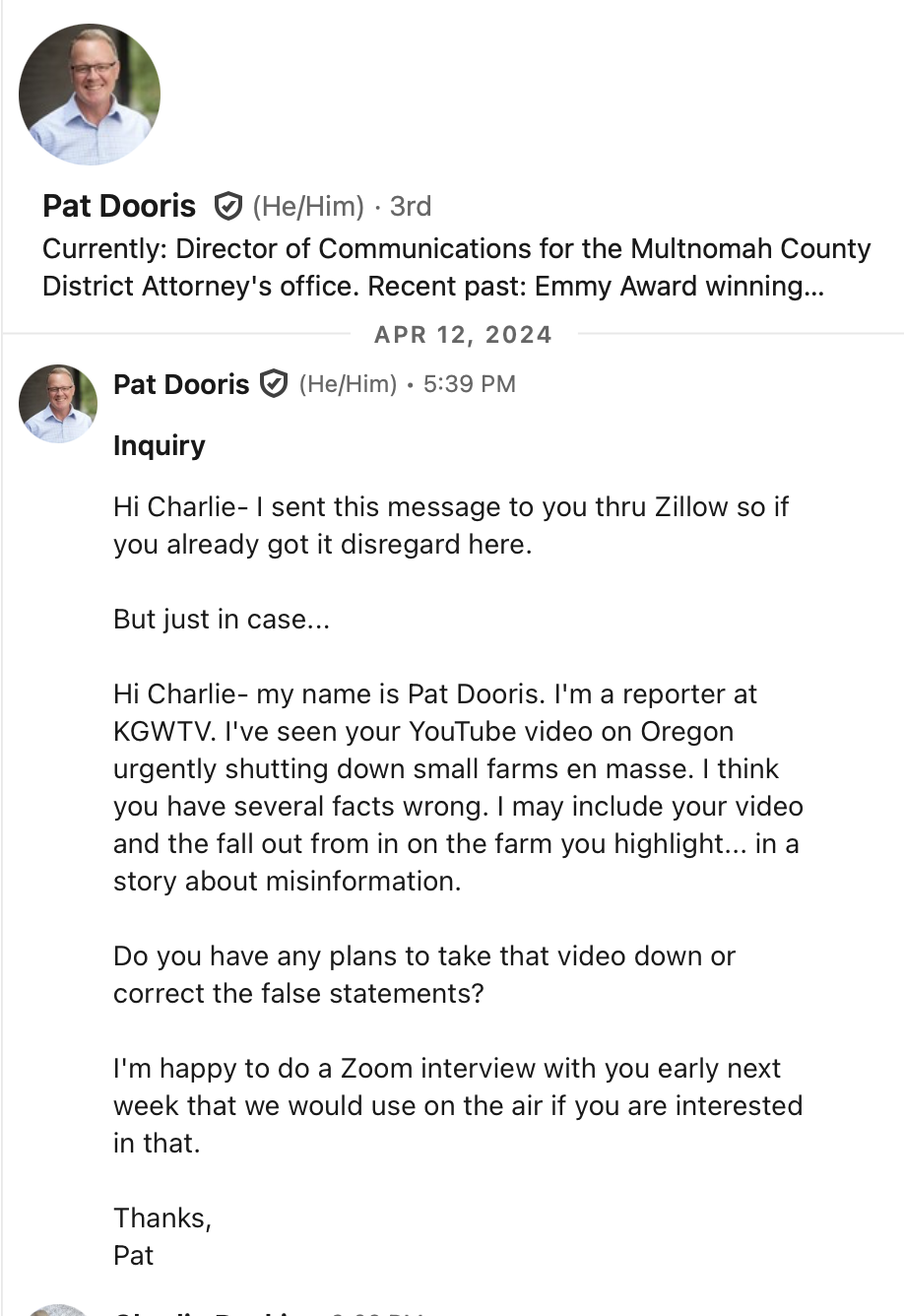
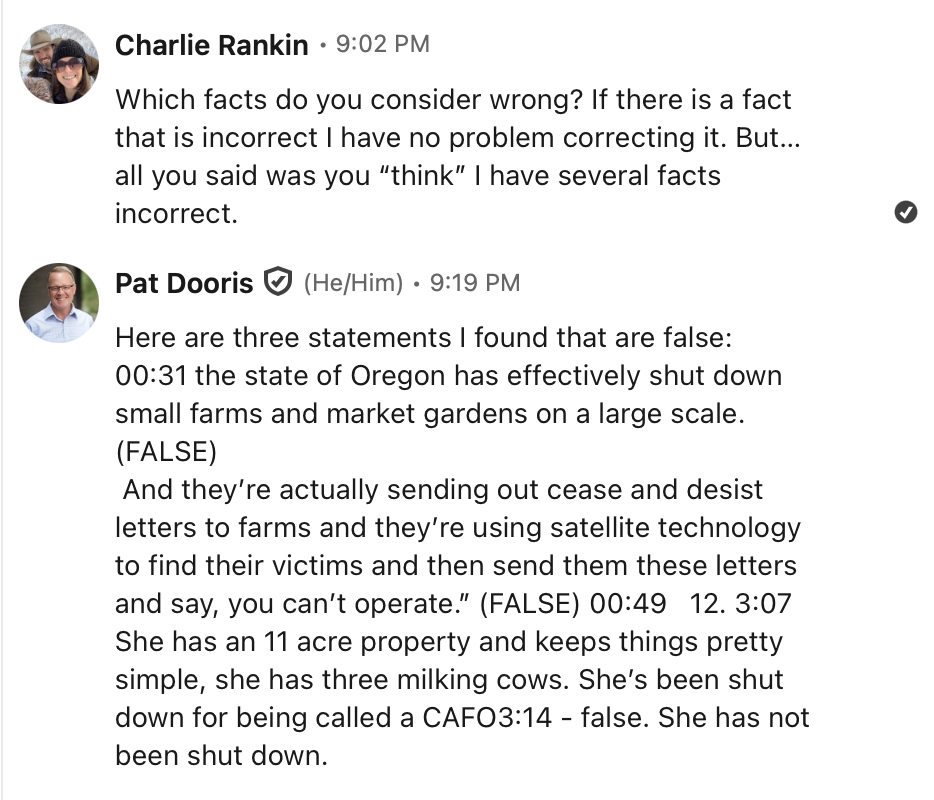
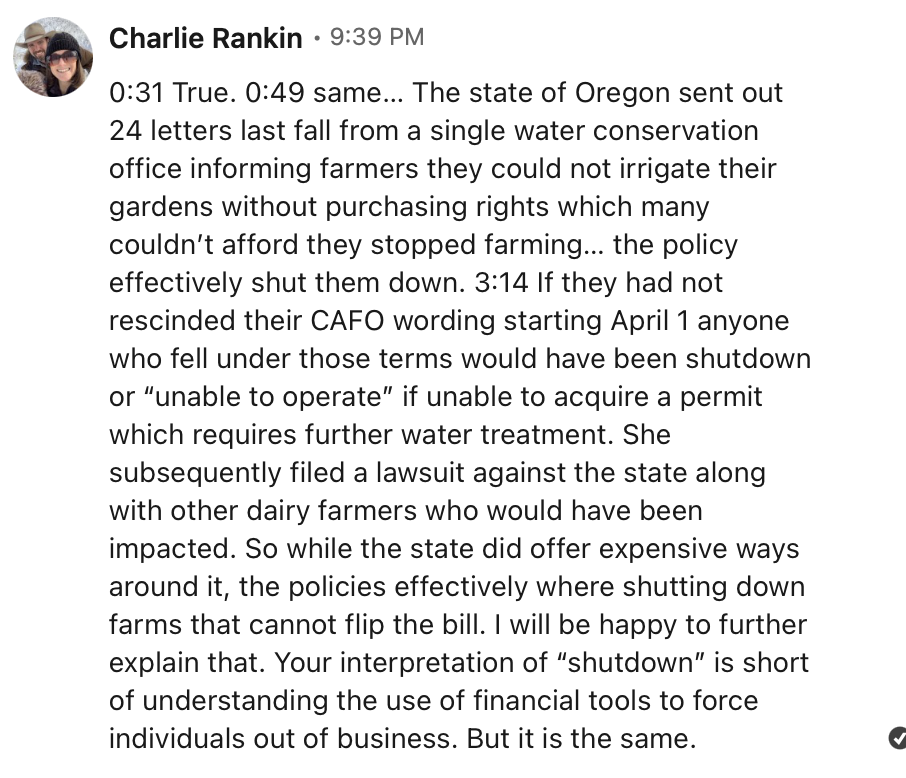
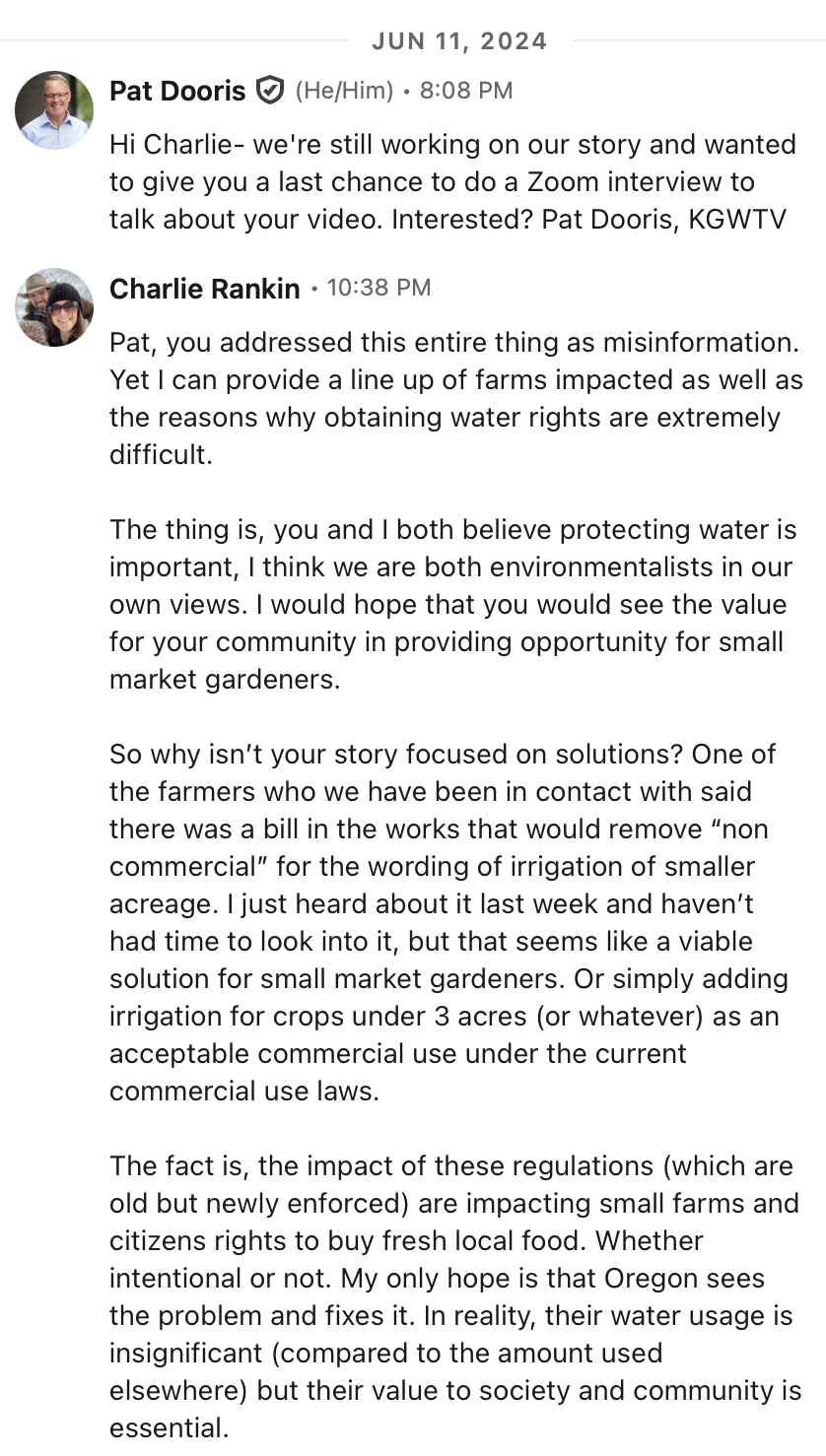
The following LinkedIn correspondence occurred on April 12 and June 11, 2024, before KGW published its report on June 25, 2024. The screenshots are presented chronologically. We have cropped unrelated profile information and interface elements but have not altered the participants’ names, dates or substantive messages. A transcript follows the images for accessibility and searchability.
Transcript of prepublication LinkedIn correspondence
April 12, 2024
Pat Dooris — 5:39 PM
Inquiry
Hi Charlie- I sent this message to you thru Zillow so if you already got it disregard here.
But just in case…
Hi Charlie- my name is Pat Dooris. I’m a reporter at KGWTV. I’ve seen your YouTube video on Oregon urgently shutting down small farms en masse. I think you have several facts wrong. I may include your video and the fall out from in on the farm you highlight… in a story about misinformation.
Do you have any plans to take that video down or correct the false statements?
I’m happy to do a Zoom interview with you early next week that we would use on the air if you are interested in that.
Thanks,
Pat
Charlie Rankin — 9:02 PM
Which facts do you consider wrong? If there is a fact that is incorrect I have no problem correcting it. But… all you said was you “think” I have several facts incorrect.
Pat Dooris — 9:19 PM
Here are three statements I found that are false: 00:31 the state of Oregon has effectively shut down small farms and market gardens on a large scale. (FALSE)
And they’re actually sending out cease and desist letters to farms and they’re using satellite technology to find their victims and then send them these letters and say, you can’t operate.” (FALSE) 00:49 12. 3:07 She has an 11 acre property and keeps things pretty simple, she has three milking cows. She’s been shut down for being called a CAFO3:14 – false. She has not been shut down.
Charlie Rankin — 9:39 PM
0:31 True. 0:49 same… The state of Oregon sent out 24 letters last fall from a single water conservation office informing farmers they could not irrigate their gardens without purchasing rights which many couldn’t afford they stopped farming… the policy effectively shut them down. 3:14 If they had not rescinded their CAFO wording starting April 1 anyone who fell under those terms would have been shutdown or “unable to operate” if unable to acquire a permit which requires further water treatment. She subsequently filed a lawsuit against the state along with other dairy farmers who would have been impacted. So while the state did offer expensive ways around it, the policies effectively where shutting down farms that cannot flip the bill. I will be happy to further explain that. Your interpretation of “shutdown” is short of understanding the use of financial tools to force individuals out of business. But it is the same.
June 11, 2024
Pat Dooris — 8:08 PM
Hi Charlie- we’re still working on our story and wanted to give you a last chance to do a Zoom interview to talk about your video. Interested? Pat Dooris, KGWTV
Charlie Rankin — 10:38 PM
Pat, you addressed this entire thing as misinformation. Yet I can provide a line up of farms impacted as well as the reasons why obtaining water rights are extremely difficult.
The thing is, you and I both believe protecting water is important, I think we are both environmentalists in our own views. I would hope that you would see the value for your community in providing opportunity for small market gardeners.
So why isn’t your story focused on solutions? One of the farmers who we have been in contact with said there was a bill in the works that would remove “non commercial” for the wording of irrigation of smaller acreage. I just heard about it last week and haven’t had time to look into it, but that seems like a viable solution for small market gardeners. Or simply adding irrigation for crops under 3 acres (or whatever) as an acceptable commercial use under the current commercial use laws.
The fact is, the impact of these regulations (which are old but newly enforced) are impacting small farms and citizens rights to buy fresh local food. Whether intentional or not. My only hope is that Oregon sees the problem and fixes it. In reality, their water usage is insignificant (compared to the amount used elsewhere) but their value to society and community is essential.
The “political campaign” characterization
KGW opened its segment by saying Yanasa TV had made Sarah King “the face of a political campaign” she did not agree with. The report never identified that campaign.
KGW later introduced Steve Smith, an Arizona State University political-science professor described as someone who had studied how political groups cherry-pick information to advance a narrative. Importantly, KGW told viewers that Smith was “talking in general.”
Smith discussed how some media creators use selected facts and emotional appeals to frighten audiences, “fabricate” a larger picture and generate conspiracy or lies. KGW placed those generalized remarks immediately alongside its criticism of Yanasa TV. Later, after the reporter described the messages Sarah King had received, Smith referred to the effect of “that kind of an ad.”
Those comments may be relevant as general criticism of persuasive media. But KGW did not tell viewers whether Smith had watched Yanasa TV’s complete report, reviewed the government records and farmer accounts on which it relied, examined Yanasa TV’s prepublication responses or independently evaluated each disputed statement. On the record KGW presented, his generalized comments were not an expert factual finding that Yanasa TV fabricated this story.
That distinction matters. A specialist can reasonably criticize a video’s tone, editing, headline and use of emotion. Yanasa TV’s report used urgent language, criticized government policy and advocated for small farms. But describing a report as “ad-like” does not establish that it was commissioned, financed or controlled as political advertising.
KGW identified no candidate, political party, political action committee, ballot-measure committee, campaign payment, sponsorship arrangement or coordination agreement connected to Yanasa TV’s reporting. It presented no evidence that Yanasa TV produced the report for an organized political campaign. Yanasa TV independently covered a public regulatory dispute and advocated for policy changes.
Sarah King was entitled to disagree with Yanasa TV’s wording, presentation or conclusions. She was also entitled to object if unrelated third parties subsequently used her story for purposes she did not support. But her disagreement—or later circulation of the report by political actors—does not establish that Yanasa TV produced it for those actors or enrolled King in an organized campaign.
If KGW meant only that the report appeared persuasive or “ad-like,” it should have identified that as an opinion about presentation. If it meant that third parties used the report politically, it should have identified those parties and distinguished their conduct from Yanasa TV’s. If it has evidence that Yanasa TV organized, financed or acted on behalf of a political campaign, we invite KGW to produce it and we will review it publicly.
The editorial construction is itself relevant. KGW criticized Yanasa TV for stitching selected information into a larger narrative, while placing a professor’s expressly generalized remarks about fabrication, conspiracy and lies into a segment about Yanasa TV. Viewers should have been told clearly where the professor’s general media criticism ended and KGW’s specific characterization of Yanasa TV began.
What a complete characterization would have said
A complete account would have presented Yanasa TV’s wording errors alongside the documented regulatory consequences:
- Yanasa TV’s headline compressed two distinct Oregon controversies—market-garden water enforcement and dairy CAFO enforcement—and used “en masse” more broadly than the available evidence could quantify. The record did not establish a verified statewide count of completed farm closures. It did, however, document multiple farms and regions facing lost commercial production, substantial compliance costs or possible closure.
- Yanasa TV incorrectly called the Water District 2 communications “cease-and-desist letters” and referred specifically to satellite technology. The agency and contemporaneous reporting described the communications as notices or informational compliance letters and confirmed the use of aerial photography, complaints and field observations—not necessarily satellite imagery. But the distinction in form should not obscure their practical effect: Oak Song Farm was notified that it could not continue irrigating commercial crops without a water right, and its operator subsequently described the business as essentially destroyed.
- Sarah King and Godspeed Hollow Farm had not already been formally closed when Yanasa TV reported on the case. ODA’s policy was nevertheless scheduled for enforcement beginning April 1, 2024. After King and three other farmers filed a federal lawsuit, ODA withdrew the policy before that date and did not enforce it while developing replacement rules. The threatened consequences did not occur because the challenged policy was withdrawn—not because the compliance burden had been imaginary.
- The federal complaint documented distinct injuries to all four dairy plaintiffs. Sarah King alleged compliance costs ranging from at least $10,000 to potentially more than $100,000 and the possibility of eventual closure. Christine Anderson had already obtained a CAFO permit and alleged costly operational changes. Melissa Derfler alleged expenses she was unlikely to be able to afford and potential eventual closure. Waneva LaVelle alleged that she would stop milking goats and would likely shut down if the policy took effect.
- ODA’s own materials said raw-milk dairies would generally be considered small CAFOs under its interpretation. The dispute therefore extended beyond Sarah King’s individual farm and raised consequences for other small dairy operators using similar milking and wastewater practices.
- Oregon later adopted narrower CAFO rules. In court filings, the state clarified that none of the four plaintiffs would be subject to the revised requirements, after which the plaintiffs voluntarily dismissed their lawsuit.
- The market-garden controversy was also larger than a single misunderstanding. OWRD sent 24 letters in one batch within Water District 2; some recipients established that their use was lawful, while others faced the loss of commercial irrigation. Contemporaneous reporting and small-farm advocates warned that the cost, delay and limited availability of alternative water rights could force other growers to stop selling crops or drastically change their operations.
- Before KGW published its report, Yanasa TV asked the reporter to identify the disputed statements, responded to each allegation in writing, offered affected-farm sources and proposed discussing practical policy solutions. Yanasa TV also publicly addressed the dispute before KGW’s segment aired.
- KGW was entitled to examine and criticize Yanasa TV’s wording. But its report did not present evidence establishing that Yanasa TV was acting for, coordinating with or operating as part of an organized political campaign.
We accept responsibility for using a headline broader than the available count could establish, describing the water notices as cease-and-desist letters, referring specifically to satellite imagery and describing Sarah King as already shut down. Those corrections matter. They do not erase the documented economic consequences, the scheduled dairy enforcement, the policy withdrawal that prevented that enforcement or the experiences of other affected farms. A fair characterization should acknowledge both.
Invitation to KGW
Yanasa News invites KGW, Pat Dooris, Sarah King, the Oregon Department of Agriculture, the Oregon Water Resources Department, Friends of Family Farmers and the Institute for Justice to submit corrections, documents or a response.
We will publish a substantive KGW response in full or link to it prominently, subject only to reasonable limits for privacy, legality and length. If any primary record contradicts this article, we will correct the article and preserve a dated description of the change below.
Primary records and contemporaneous sources
Water enforcement
- OWRD agency statement concerning the 24 letters, March 29, 2024
- Oregon Revised Statute 537.545
- OPB/KLCC report on Oak Song Farm and the 24 notices, March 13, 2024
- Oregon Farm Bureau, “A Clarification Regarding Recent Government Actions and Small Family Farms,” April 1, 2024
- Friends of Family Farmers’ contemporaneous explanation, April 1, 2024
- HB 3372 legislative record, 2025
- Official HB 3372 written-testimony index
- Odonata Farm testimony submitted for HB 3372
- KEPW’s edited transcript of testimony presented during the April 7, 2025 HB 3372 hearing
Dairy CAFO policy and litigation
- Federal complaint, filed January 23, 2024
- ODA’s January 2023 white paper, identified and quoted in the federal complaint
- ODA’s January 2023 outreach and enforcement program document, identified and quoted in the federal complaint
- ODA withdrawal announcement, March 21, 2024
- Current Oregon Administrative Rules, Division 74
- Plaintiffs’ notice of voluntary dismissal, filed October 2, 2024
- Institute for Justice case page and docket documents
- OPB/KLCC report on the final rules and dismissal, October 10, 2024
Archival note: The original ODA URLs for the January 2023 white paper and outreach and enforcement program document now redirect to the agency’s general Natural Resources page. The documents are identified, quoted and cited in the federal complaint linked above. Those redirecting URLs are not represented here as functioning archived copies.
The disputed reporting and correspondence
- Yanasa TV’s original report, March 18, 2024
- Yanasa–KGW prepublication correspondence, April 12 and June 11, 2024—screenshots and transcript reproduced in this article
- Yanasa TV’s public response, May 3, 2024
- Yanasa TV’s follow-up report, May 20, 2024
- KGW’s article, June 25, 2024
- KGW’s complete video report, June 25, 2024
- KGW’s Steve Smith discussion, approximately 8:21–11:35
- KGW’s “that kind of an ad” characterization, approximately 11:04
Corrections and updates
This section will remain visible. Corrections will state what changed, why it changed and the date of the amendment. Minor spelling or formatting changes may be made without a separate entry.
- June 28, 2024: Initial publication.
- September 14, 2026: Article substantially rewritten after a review of the full public record. Added four specific corrections, separated the water and dairy disputes, documented the four dairy plaintiffs’ alleged injuries, added the subsequent policy and legal outcomes, described Yanasa TV’s prepublication responses, addressed KGW’s political-campaign characterization, and expanded the primary-source record.